
How to choose an electric bike?
Try the guide
by choosing electric bikes
Find the ideal model for your needs
I want to choose an electric bike
When choosing an electric bike, you first need to proceed as you would when choosing a regular bike - this means clarifying:
- What purpose will the bike serve? (transportation, sports, tourism, etc.)
- Where will you ride your bike most often and on what roads? (roads, cycle paths, forest and field paths, all types?)
- What riding style (type of sitting) should the bike provide (sporty – more forward leaning or more upright, comfortable?)
- How often and how far will you ride your bike? (how many times a week, how many kilometers?)
- what other functions do you need – compactness (frequent transportation), carrying luggage, equipment for riding in the wet, in the dark, etc.

Depending on the individual answers, you can lean towards one of the basic types of bikes:
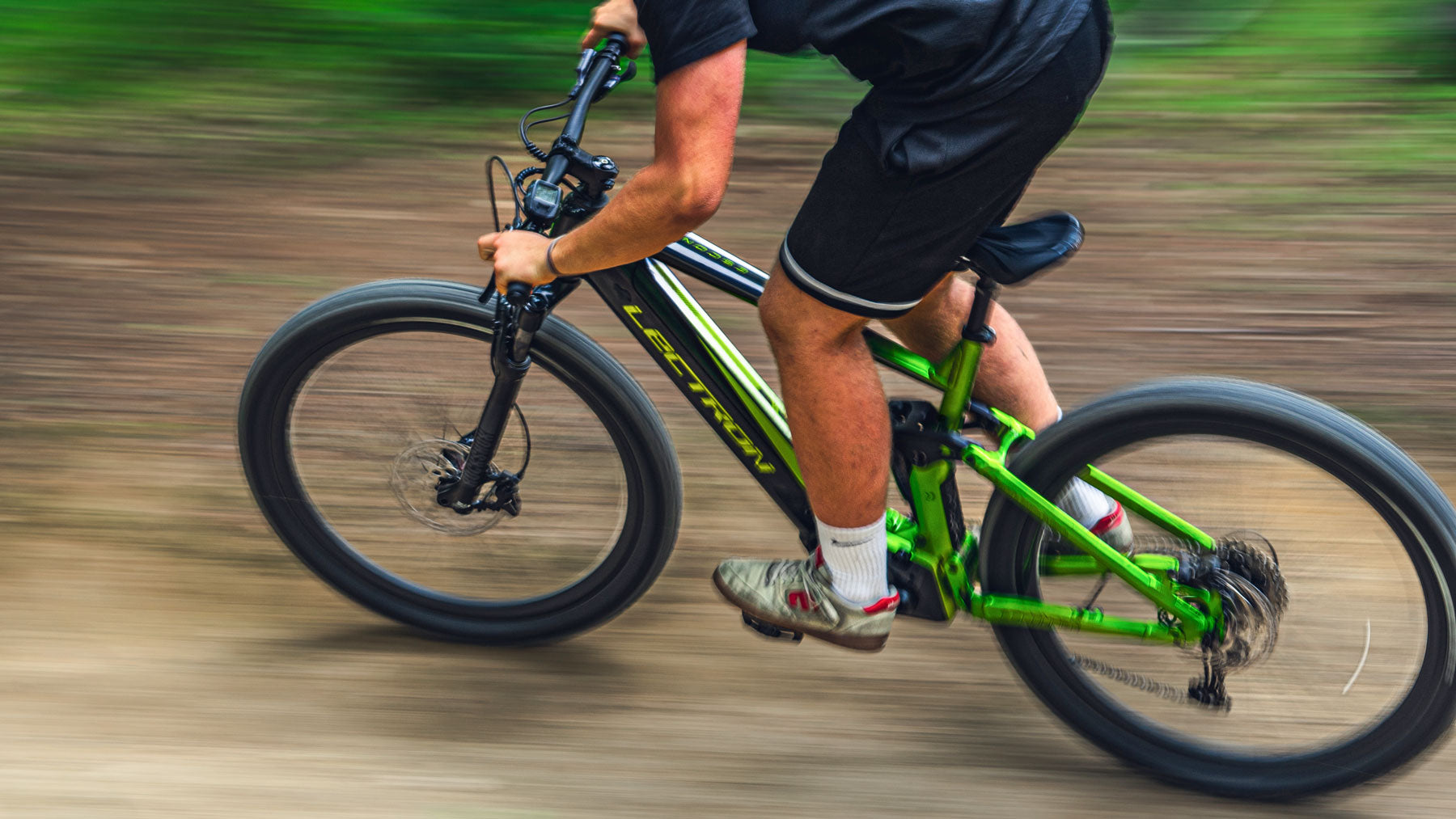
Mountain bikes (MTB)
The bikes are designed for riding on a variety of terrain, from easy to difficult. They can also be ridden on the road, but the type of tires, suspension travel, and frame geometry are not ideal for riding on the road. The type of terrain and riding style (sports, recreational, touring) and the appropriate bike equipment are also important. In the case of electric MTBs, it must be assumed that the electric equipment increases the weight of the bike, and electric mountain bikes are usually designed for easy to moderately difficult terrain. The level of equipment is also lower for electric mountain bikes and, given the expected use, is sufficient.In some cases, MTBs have their own men's and women's versions. In the men's version, the upper beam tube is led up, in the women's version it is lowered - running diagonally down from the steering head. However, more athletically built women usually choose the "men's" versions of the frames, which are more rigid.
Mountain bikes can be adapted more for road riding, for example by fitting narrower tires, retrofitting with fenders, lights, etc., then their use is more universal, while maintaining their off-road potential.
Trekking/cross bikes
Bikes designed for both light terrain and roads and cycle paths. This bike is chosen by a cyclist who intends to travel on various types of roads and on the road. He gets into the terrain more by mistake, but he sometimes has to ride on a dusty road during his tourist wanderings. Prepared field and forest roads, cycle paths and road crossings. The frame geometry provides a more comfortable - more upright position than on mountain bikes. This type of bike has recently become very popular and is directly intended for cycle tourism.The term "cross" bikes is a bit misleading, as it evokes difficult terrain a la motocross for some, while for others it evokes bikes designed for traditional cyclocross. The previously established term "trekking" bikes refers to a similar category of bikes, which, however, is usually distinguished by equipment more adapted to longer trips on roads (racks, mudguards, lights). Both categories of bikes tend to have narrower and less off-road tires than mountain bikes, and the wheels are also larger in diameter, usually 28″.
These bikes usually come in men's and women's versions. In the men's version, the top frame tube is led up, while in the women's version it is lowered - running diagonally downwards from the steering head.
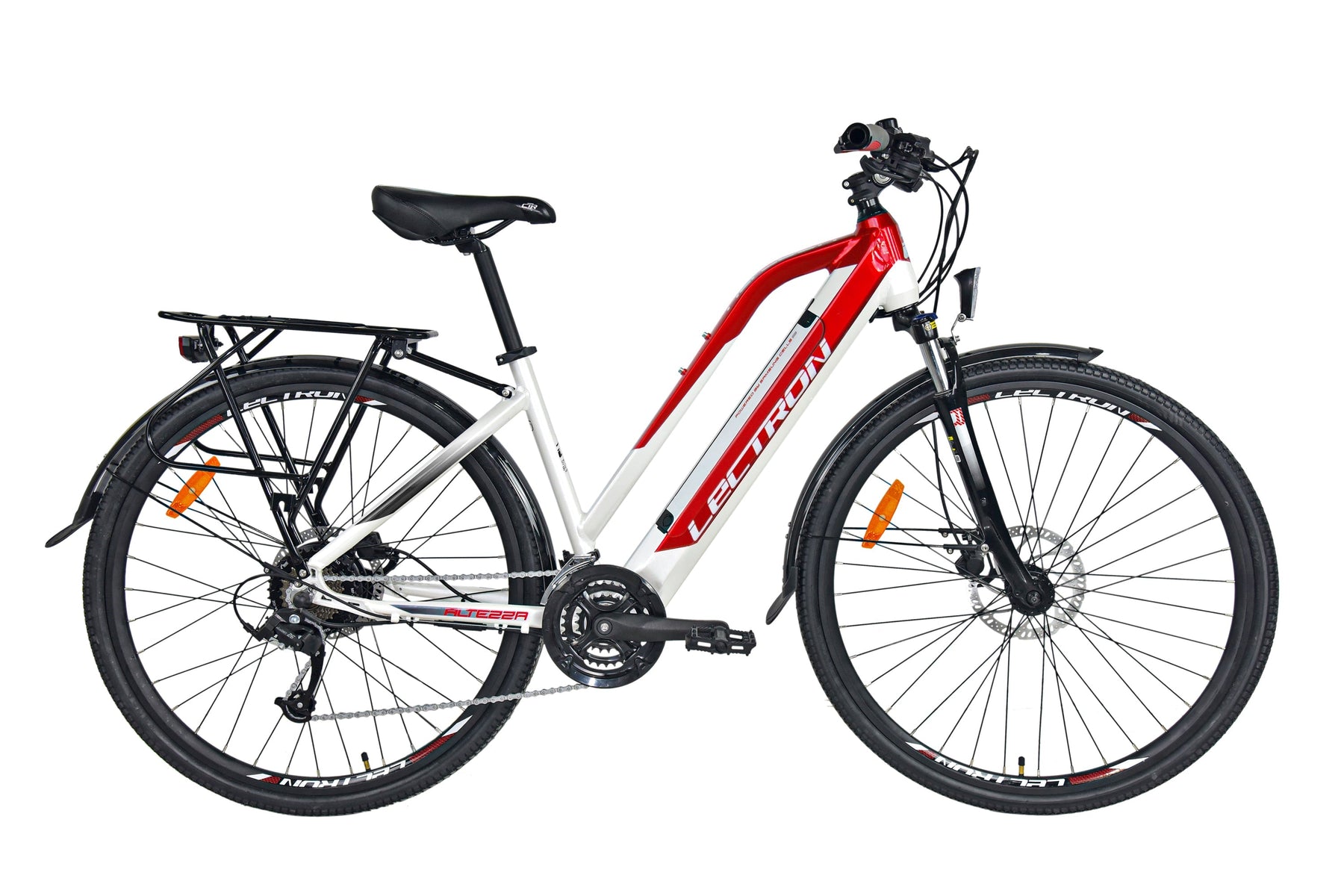
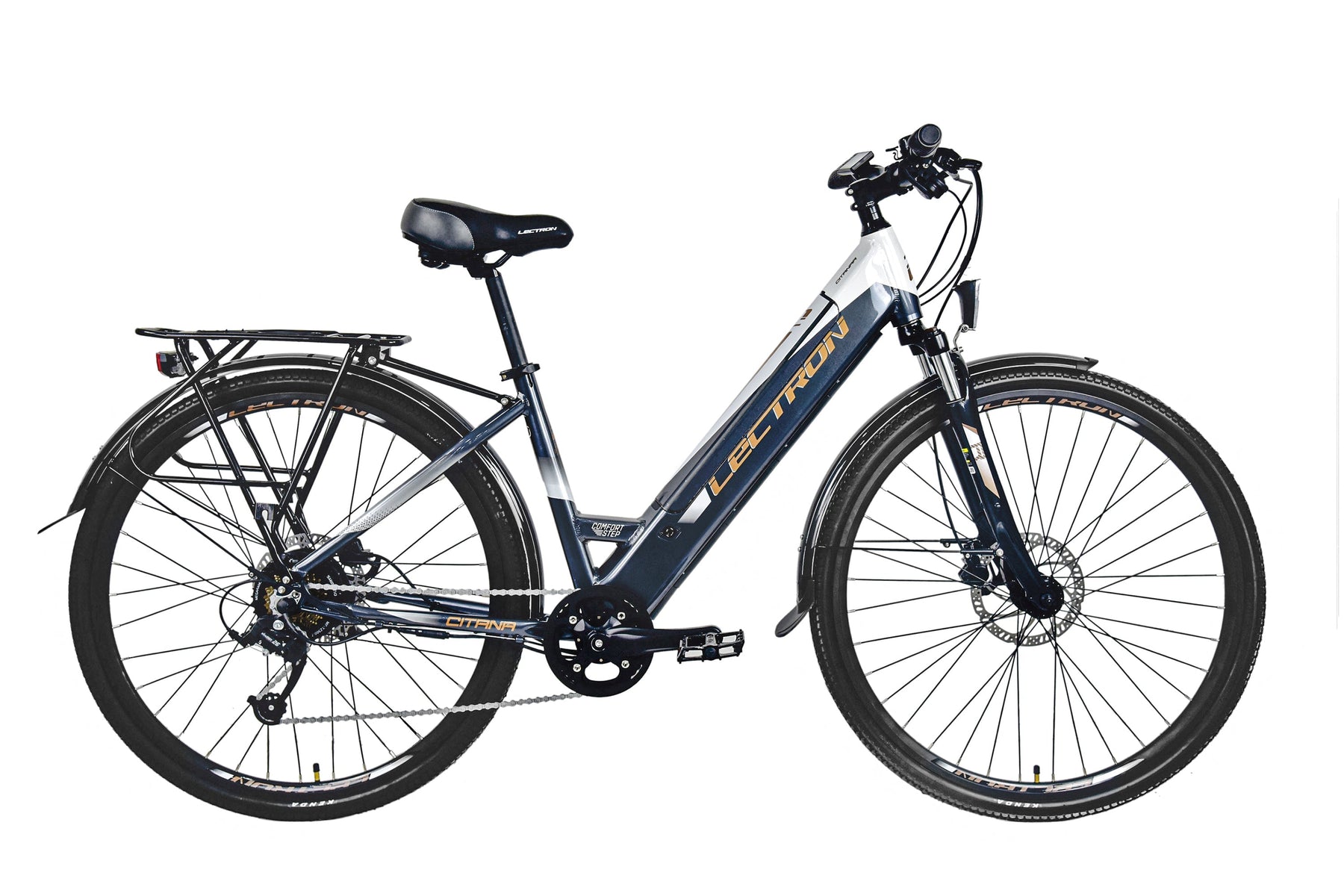
City bikes and touring bikes
Touring bikes are designed mainly for roads and paved roads. It is less suitable to use this type of bike in the field, but riding on paved roads usually does not cause problems. A touring bike is suitable due to its equipment (mudguards, lights, rack, etc.) as a pleasant means of transport. The geometry of the frame is usually adapted to longer trips (upright seat) and the equipment of the electric bike is also adapted to road trips (shorter suspension travel, more comfortable saddle, shape of handlebars, etc.). These bikes are chosen mainly by cyclists who use their bike for trips on roads and paved roads, in a comfortable style.Bikes in this category tend to have men's and women's versions. In the men's version, the upper frame tube is led upwards, in the women's version it runs diagonally downwards from the handlebars. These bikes are very similar in type to city bikes.
City bikes and cruisers are adapted to urban conditions. The frame is usually adapted for easy boarding, even in city clothes. Travel is expected to be shorter distances in city traffic. They are equipped with fewer gears. The frame has a geometry for a completely upright sitting position. Women's versions feature full chain cover, baskets, etc. Variants that make boarding as easy as possible, suitable for seniors, are also common. Cruisers also come in retro designs, representing an expression of style. Single-speed types are also gaining popularity.
Road bikes
These bikes (simplified by the former Favorit) are intended more for sporty riding on roads. The frame geometry is designed for low aerodynamic resistance and low weight, the tires are thin, the frame is unsprung. They are only found sporadically in the e-bike category and are built more to order.Next, you need to determine the appropriate frame size:
| height of the figure in cm | frame height and marking |
|---|---|
| up to 165 cm | 15″, 16″, S, up to 44 cm, up to 500 mm |
| 160 – 170 cm | 17″, 18″, M, up to 48 cm, up to 520 mm |
| 170 – 185 cm | 18″, 19″, L, up to 52 cm, up to 540 mm |
| 185 – 200 cm | 19″, 21″, XL, up to 55 cm, up to 560 mm |
| over 195 cm | 21″-24″, 58-60cm, over 580mm |
Wheel diameters (in inches)
- 10″ -24″ – children's bikes
- 20″ small folding wheels
- 26″, 28″ city and touring bikes
- 26″, 27.5″, 29″ – mountain bikes
- 27″, 28″ – cross, trekking and road bikes
2) Next, you need to consider the individual requirements for the bike's electrical equipment:
What type of electrical equipment would be best suited in terms of:
a) Physical requirements and riding style, i.e. to what extent you will need the assistance of the bike:
Will you rather rely on constant motor assistance, or are you more interested in the characteristics of a regular bike, where you will only use occasional assistance uphill?
How far will you ride, how often will you have the opportunity and desire to recharge the bike?
What type of motor control (control function) will you need?
Depending on your requirements, choose a sufficient battery capacity, number of gears and control method. For riding shorter distances, e.g. for seniors on roads, a smaller number of gears is more suitable, and easier handling, e.g. an LED control panel. For longer trips in varied terrain and riding styles, higher battery capacities, more gears and assistance settings are suitable. For sporty riding, where the battery is more of a reserve, the equipment will be equivalent to a regular trekking or mountain bike, with enough gears, appropriate equipment and a favorable weight.
Keep in mind that the range of an electric bike decreases significantly in bumpy terrain, but also when starting frequently in the city. The weight of the rider, headwinds and the quality of the surface you are riding on also play a role. It is therefore advisable to choose a battery capacity with a margin to avoid discomfort and the risk of the electric bike running out prematurely. Riding is then more difficult than on a regular bike due to the higher weight. With a stronger battery, you also extend the battery life thanks to the less frequent need for charging.
b) Which design concept of an electric bike will suit you best, given your style of use?
This mainly concerns 2 design parameters – battery position and motor position. Some other sellers may baselessly praise one type of arrangement, but the reality is that each type has its advantages and disadvantages.
E-bike battery position
Classic batteries are most often cuboid in shape and are placed either at the back along the seat tube or flat on the carrier of the e-bike. Alternatively, the battery is placed on the front frame tube, then it has a rounder or even cylindrical shape (like a bottle). In new types of e-bikes, the battery is increasingly being integrated with the frame, or placed in the frame tube, so that the appearance of the bike is as little disturbed as possible.
The main criterion for choosing a faucet in this case is rather the customer's aesthetic preferences, because each arrangement has its pros and cons.
The position of the wheel's center of gravity is particularly affected by different battery positions.
- The battery on the carrier has a higher center of gravity and can therefore affect the bike's handling a little more, but it can also blend in with the carrier in a suitable way and allow the frame area to be free like on a regular bike (for a bottle, handbag, etc.).
- The battery behind the seat tube has the lowest center of gravity, which is advantageous, but requires frame modification and makes it impossible to use a front derailleur (as a result, the bike has fewer gears).
- The battery on the front frame tube can get in the way of your knees and make it difficult to fit a water bottle or handbag. Also, the limited volume has not yet allowed for higher capacity (except for the 2014 Lectron models). However, in the case of a rear wheel motor, the battery in the frame benefits from front-to-rear weight distribution.

E-bike motor position
The motor can be located in the rear wheel, in the center of the pedals, or in the front wheel.
- So far, the most widespread location is in the rear wheel, where there is optimal downforce on the driven wheel and rolling inertial forces are well absorbed (you don't turn with the driven wheel).
- The motorization in the front wheel provides a slightly better weight distribution (if the battery is located at the rear). When riding uphill and “pulling” the handlebars, moving on unpaved roads or slippery surfaces, the driven wheel may slip. The greater weight of the front wheel also slightly negatively affects handling. Overall, the concept of a driven front wheel is more suitable for a quieter ride on a quality surface – the city and undemanding, mainly road tourism.
- The mid-drive is a less common concept. Its minor drawback is the increased stress on the chain, gears and derailleur (the engine power is transmitted through the chain and gears). The number of gears is also limited and the purchase price is higher. On the other hand, the engine operates in a smaller (more favorable) speed range and the weight is concentrated more in the center of the pedaling.

c) What should be the level of equipment, weight and aesthetics?
In relation to practical use, it is worth considering what type of control you prefer - whether simpler settings - a diode or LCD panel with 3-4 levels of assistance or more sophisticated LCD panels with multiple functions and setting multiple levels of assistance.
- From a practical point of view, it is important that the bike suits the method of use, especially the size, type and shape of its frame - the rider's seating position .
- The mechanical components include the number and type of gears, the brakes used and, in the case of a suspension bike, the type of fork. For light use, even the lowest levels of equipment can be sufficient – e.g. Shimano SIS, Zoom brakes, etc., but they have a shorter lifespan. For recreational and tourist use, the equipment should be at least Shimano Altus or Acera and higher level brakes (Shimano, Tektro..)
- Last but not least, it is good to take into account the weight of the electric bike not only for riding, but also for possible handling, storage, etc. The battery design has a significant influence here, where most bikes now use lightweight lithium cells, as well as the frame design, which is overwhelmingly made of aluminum alloys. However, overall, there are differences of 2-5 kg between the weights of individual types, which can play a significant role both for maneuverability and for riding without a motor or handling.
d) Last but not least, how much are you willing to invest in the bike?
Broadly speaking, the market offer can be divided as follows:
- The price category up to 23,000 CZK incl. VAT today represents the basic level of electric bikes and their equipment (small folding bikes usually always fall into this category).
- The average price level usually lies between 23,000 and 32,000 CZK. However, even in this category we find significant differences in equipment and design.
- Bikes with above-standard equipment can be found in the category from 33,000 to 45,000 CZK. At these prices, one can rightly expect some above-standard parameters.
- Above 45,000, there are bikes from more expensive European brands or with more expensive engines (e.g. Bosch, BionX), or new e-bike concepts.